Philosophy

Conceptual Ethics and the Methodology of Normative Inquiry

Decorative image
Type: 
Budapest colloquium talks
Building: 
Nador u. 15
Room: 
103
Date: 
October 17, 2017 - 3:30pm to 5:10pm

Conceptual ethics concerns a range of issues about the normative and evaluative assessment of concepts and words. It includes, centrally, the  assessment of which concepts a given agent should use (in a given context), and the assessment of which words an agent should use (in a given context) to express those concepts. In this paper, we address the conceptual ethics of normative inquiry. We understand normative inquiry in broad terms. It encompasses inquiry into what agents should do, think, or feel, and into what should or ought to be the case.


Objectivity and Perspectival Content

Decorative image
Type: 
Budapest colloquium talks
Building: 
Nador u. 15
Room: 
103
Date: 
February 6, 2018 - 3:30pm to 5:10pm

What is objectivity and is there such a thing? What would it take to have objective representations and do we (humans) have what it takes? This paper aims to contribute to answering these questions. To this end, it isolates one relevant sense of objectivity and proposes a generalization of standard frameworks of representational content in order to engage with the question in a way that is rhetorically fair.

Knowing What It Is Like and Learning from Others

Decorative image
Type: 
Budapest colloquium talks
Building: 
Nador u. 15
Room: 
103
Date: 
November 28, 2017 - 3:30pm to 5:10pm

It is often said that 'what it is like'-knowledge cannot be acquired by consulting testimony or reading books [Lewis 1998; Paul 2014; 2015]. However, people also routinely consult books like What It Is Like to Go to War [Marlantes 2014], and countless 'what it is like' articles, blogs, and youtube videos, in the apparent hope of gaining knowledge about what it is like to have experiences they have not had themselves. This paper examines this puzzle and tries to solve it by appealing to recent work in epistemology and the philosophy of mind on knowing-wh ascriptions.

10th In-house Graduate Philosophy Conference

Building: 
Nador u. 15
Room: 
202-203.
Date: 
October 13, 2017 - 10:00am to October 14, 2017 - 4:30pm

All students who completed one year in the program are asked to present their work at the In-house Doctoral Conference. The purpose of the event is to give students the chance to present and discuss their research and learn about each others' work. It’ll also give us the perfect opportunity to welcome our new students.

Andrés Moles promoted to the Rank of Associate Professor

July 4, 2017
Decorative image

The Department of Philosophy is pleased to announce that Andrés Moles has been promoted to the rank of Associate Professor, valid from August 1, 2017.

Warmest congratulations, Andrés!

Cavendish on Panpsychism and Natural Order

Chris Meyns
Type: 
Budapest colloquium talks
Building: 
Nador u. 15
Room: 
103
Date: 
November 21, 2017 - 3:30pm to 5:10pm

This paper offers a new and more refined interpretation of Margaret Cavendish's panpsychist view of nature. Her panpsychism is at the core of her contributions to early modern natural philosophy. According to Cavendish, to explain the order in the natural world we must suppose that all of nature possesses sense and reason. However, so far there has not been sustained attention to the precise structure of her panpsychism. How must a sensing, rational nature be organised to explain the occurrence of natural order?

Simplicity: The Last Refuge of a Scoundrel

Decorative image
Type: 
Budapest colloquium talks
Building: 
Nador u. 15
Room: 
103
Date: 
October 24, 2017 - 3:30pm to 5:10pm

Newton and Einstein both claim that the world is simple and therefore the simplicity of a theory is a sign of its truth.  This idea has wide currency in science and philosophy.  It shouldn't have.

Aristotle and the Master Science of Life

Decorative image
Type: 
Budapest colloquium talks
Building: 
Nador u. 15
Room: 
103
Date: 
October 3, 2017 - 3:30pm to 5:10pm

At the very beginning of the Nicomachean Ethics Aristotle invokes the need of a master-science ('most architectonic'), a science that determines the good human life in a community and provides for its order and laws. If this aspect does not receive much attention in the secondary literature that seems to be largely due to the fact that after this great entrance the master-science and legislator do not receive much attention. They do, however, reemerge in the transition to the Politics in the EN's final chapter.

Laura Nicoara receives Outstanding Academic Achievement Award

June 12, 2017
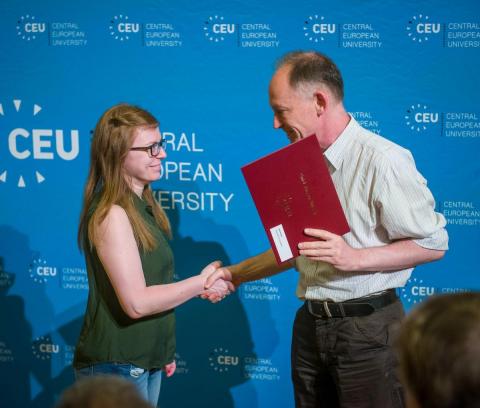
Laura & Hanoch, her supervisor

Warmest congratulations to Laura Nicoara, who has been awarded the Outstanding Academic Achievement Award for her overall academic performance in the program.

Well done, Laura!

Successful Defense of Edi Pavlovic

May 29, 2017

The Department of Philosophy is pleased to announce the successful defense of the PhD Dissertation by
Edi Pavlovic
on
The Quantified Argument Calculus: An Inquiry into Its Logical Properties and Applications