Philosophy

The Origins of Physicalism. Carnap and Wittgenstein on Psychological Sentences: 1928-1932

Decorative image
Type: 
Budapest colloquium talks
Building: 
Nador u. 9, Monument Building
Room: 
Popper (102)
Date: 
October 16, 2018 - 3:30pm to 5:00pm

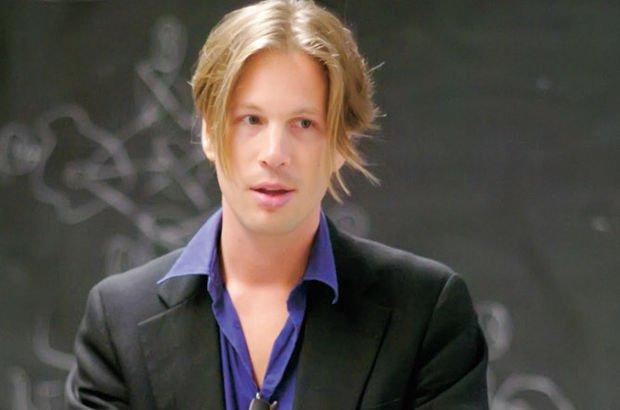
The origin of physicalism is a complex question, to which an unambiguous answer is not likely to be available –  the major reason being that there were different formulation of the doctrine, hence the inventor of physicalism may not be possible to identify.

Against Perceptual Beliefs

Decorative image
Type: 
Budapest colloquium talks
Building: 
Nador u. 15
Room: 
103
Date: 
October 9, 2018 - 3:30pm to 5:00pm

You are looking at a red apple. Your perceptual state gives rise to a perceptual belief that the object in front of you is red. Further, your perceptual state justifies your perceptual belief. This is the standard story about perceptual justification, which is understood as a relation between perceptual states and perceptual beliefs. The aim of this paper is to investigate one of these two relata of perceptual justification: that of perceptual belief. I argue that there is no unproblematic way of delineating perceptual beliefs from non-perceptual beliefs.

The Structure of Substances: Why Some Properties Are Essential

Decorative image
Type: 
Budapest colloquium talks
Building: 
Nador u. 15
Room: 
103
Date: 
September 27, 2018 - 5:30pm to 7:00pm

Many philosophers distinguish between the essential and accidental properties of people, animals, artefacts, species, chemical substances and other things. Other philosophers dismiss this distinction as arbitrary and groundless. I shall explain how substances are items whose instances share many properties, and how any such substance must have one super-explanatory property that accounts for this multiple sharing of other properties. I then argue that essential properties are just those properties that are super-explanatory.

Péter Susánszky receives Outstanding Academic Achievement Award

July 13, 2018
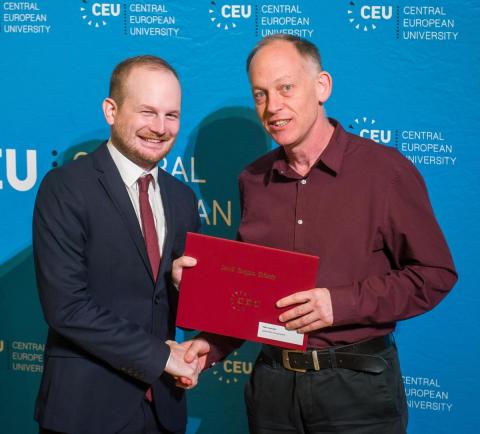
Péter and Hanoch, his supervisor

Warmest congratulations to Péter Susánszky, who on June 21 has been awarded the Outstanding Academic Achievement Award for the academic year 2017-18, for his overall academic performance in the Philosophy Master's program.

Well done, Péter!

Why The One Did Not Remain Within Itself

Decorative image
Type: 
Budapest colloquium talks
Building: 
Nador u. 15
Room: 
103
Date: 
October 25, 2018 - 5:30pm to 7:00pm

In a fascinating forthcoming article, Mark Johnston adapts Plotinus’s ancient question to the question of why God (classically conceived) would create anything at all. As Johnson shows, the question forces us to grapple with such challenging matters as infinite and incommensurate value, the consistency of ‘arbitrary' choice and perfect practical rationality, and the Principle of Sufficient Reason. I find Johnston’s discussion insightful but incomplete in important ways. After saying why, I attempt to improve upon it.

11th In-house Graduate Philosophy Conference

Building: 
Nador u. 15
Room: 
104 and 105
Date: 
October 5, 2018 - 10:00am to October 6, 2018 - 4:30pm

All students who completed one year in the program are asked to present their work at the In-house Doctoral Conference. The purpose of the event is to give students the chance to present and discuss their research and learn about each others' work. It’ll also give us the perfect opportunity to welcome our new students.

What are the Functions of the Social Sciences in Liberal Democracy?

Decorative image
Type: 
Budapest colloquium talks
Building: 
Nador u. 15
Room: 
103
Date: 
November 20, 2018 - 3:30pm to 5:00pm

Abstract

In this paper Kusch criticizes authors -- such as S. Turner, M. Burawoy, or P. Kitcher -- who seek to define the functions of the social sciences using a Rawlsian or Habermasian conception of liberal pluralism or ideal-deliberative democracy. He defends an alternative way to think about the functions of the social sciences; this way takes its lead from R. Geuss' realist political philosophy and C. Mouffe's "agonistic pluralism".

Holism vs. Particularism: an Evidential Debate

Decorative image
Type: 
Budapest colloquium talks
Building: 
Nador u. 15
Room: 
103
Date: 
November 21, 2018 - 5:30pm to 7:00pm

Abstract

The holist claims that systems of hypotheses, not individual ones, receive evidential support.  Particularists claim that systems of hypotheses receive evidential support if and only if each hypothesis in the system does.  In the mid-19th century the philosopher John Stuart Mill and the scientist William Whewell debated this issue with respect to the wave theory of light.  To believe the theory, Mill said, you must find the ether, which is waving.  Whewell replied “not so.”  Who was right, and why?
Summer University: The History and Metaphysics of the Concept of Laws of Nature

Decorative image
Type: 
Summer University
Date: 
July 2, 2018 - 9:00am to July 10, 2018 - 7:00pm

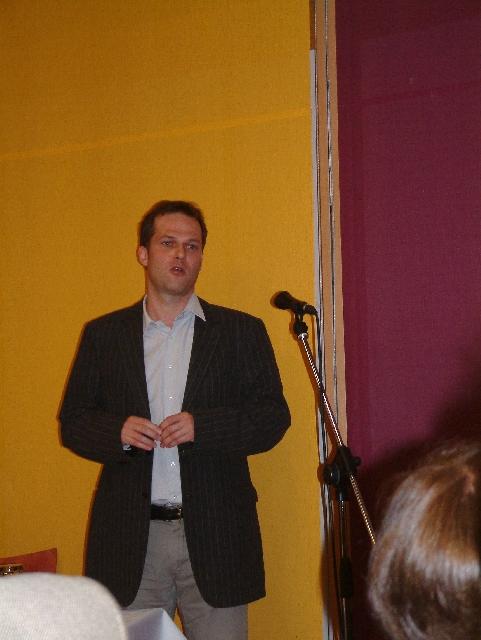
The purpose of the course is to acquaint course participants with recent work on the history and metaphysics of the concept of scientific law and related concepts that are central to the development and understanding of science. These concepts are important to philosophical accounts of both science and to metaphysics. While there has been a great deal of active research on writing on the metaphysics of laws and also on the history of the concept of laws there has been little interaction between researchers involved in each project.