Philosophy

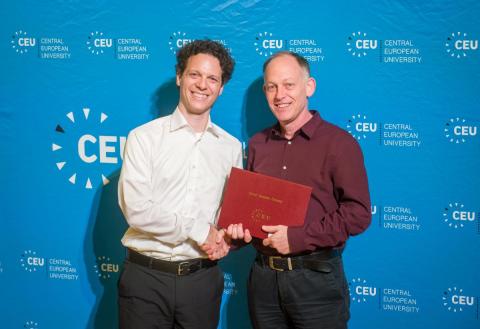
David Bitter received Best Dissertation Award

June 7, 2018
Award Ceremony with Hanoch

It is with great pleasure that we announce that, by the decision of the University Doctoral Committee, David Bitter is among the three students who received the Best Dissertation Award this academic year. David's dissertation was on "Cognitive Impenetrability of Low-Level Perceptual Features", and his supervisor was Katalin Farkas.

Congratulation, David!

History and Metaphysics of the Laws of Nature

Philippe Halsman 1948; Dali Atomicus
Building: 
Nador u. 15
Room: 
103
Date: 
July 12, 2018 - 10:00am to July 14, 2018 - 7:00pm

Laws of nature (or scientific laws) are central to the sciences, especially to fundamental physics. They provide the explanatory backbone of the sciences by grounding explanations, causal relations, predictions and counterfactuals. They are intimately related to natures of time, space, and objective probability. While it is the task of scientists to discover what laws there are, it is the task of philosophers to provide accounts of what laws are, i.e. what makes a generalization or equation express a law?
Successful Defense of David Bitter

May 11, 2018

The Department of Philosophy is pleased to announce the successful defense of the PhD Dissertation by
David Bitter
on

Science Studies in Budapest 2

Decorative image
Type: 
Workshop
Date: 
June 5, 2018 - 9:15am to 5:30pm

Science Studies in Budapest 2 is the second workshop of a series intending to bring together researchers in Budapest working on the history, philosophy and social studies of science and technology. At the one-day workshop, researchers will present their ongoing research in various fields of science studies. Students and faculty from any institution are welcome to attend. No registration is required for attendance.

For program and abstract, see event website: https://sciencestudiesinbudapest2.tumblr.com/

The Aristotelian model of character and character formation

Decorative image
Type: 
Budapest colloquium talks
Building: 
Nador u. 15
Room: 
103
Date: 
March 6, 2018 - 3:30pm to 5:10pm

The notion of character has recently come under dispute. Skeptics about character (e.g. John Doris, Gilbert Harman) deny that there is anything like cross-situational consistent and temporally stable traits of character, while philosophers and psychologists who defend the significance of character (among them e.g. supporters of affection theory) often draw on what is taken to be an Aristotelian model of character and character formation. Against this background, my talk tries to pin down the key features of Aristotle’s notion of character and his account of character formation.

Matthew Baxendale recives the Award for Advanced Doctoral Students

January 31, 2018
Decorative image

Warmest congratulations to Matthew Baxendale, who has been awarded the Award for Advanced Doctoral Students this year.

Well done, Matthew!

Spinoza's Non-Theory of Non-Consciousness

Decorative image
Type: 
Lecture
Building: 
Nador u. 15
Room: 
203
Date: 
April 26, 2018 - 4:00pm to 5:30pm

Talk Handout

Some Texts from the Ethics on Consciousness
Daniel Garber (Princeton University)

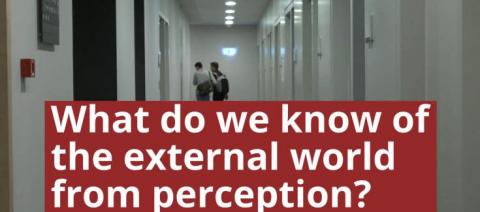
Perception of the External World - a video by Jonny Hunter

January 2, 2018
Decorative image

Please contemplate a video by our student, Jonny Hunter, assisted by our Damian Aleksiev: Philosophy of Perception at CEU. What do we know of the external world from perception? – Hear what Kati Farkas, Tim Crane, Howard Robinson and Hanoch Ben-Yami think about the question.

You can watch the video on our Videosquare page, where you can also find many other philosophy videos.

Free Will, Moral Responsibility, and Agents’ Histories

Decorative image
Type: 
Budapest colloquium talks
Building: 
Nador u. 9, Monument Building
Room: 
Popper Room
Date: 
March 26, 2018 - 5:30pm to 7:00pm

A common idea in the literature on free will and moral responsibility is that all that is needed for free action and for moral responsibility for an action is present in an agent’s internal condition at the time of action. Here, an agent’s internal condition at a time may be understood as something specified by the collection of all psychological truths about the agent at the time that are silent on how he came to be as he is at that time.

Art in Academia

Decorative image
Building: 
Arany Janos u. 32
Room: 
Centrális Galéria