Philosophy

The Department Has Moved to Nádor 13

September 5, 2016
Decorative image

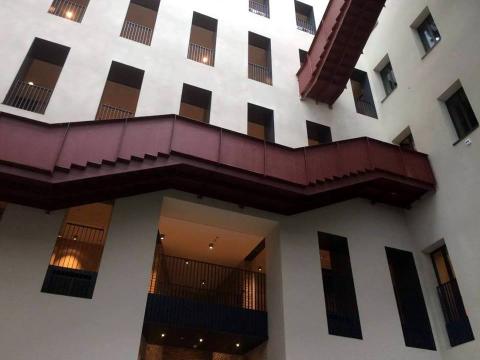
On Thursday, August 25, the Department of Philosophy moved to its new location: 13 Nádor Street, Second Floor. All the faculty whose primary affiliation is with Philosophy, the coordinator and assistant, and the new PhD Lab are now located at the new address. Phone numbers and postal address (9 Nádor St) remain unchanged.

Melding Minds with Colleagues

Type: 
Budapest colloquium talks
Building: 
Nador u. 15
Room: 
103
Date: 
November 29, 2016 - 5:30pm to 7:00pm

The extended mind hypothesis (EM) claims that some of our mental states/processes extend outside our heads and into objects in our environment. To date, attention has focused on mental extension into otherwise non-mental artefacts (notebooks, diaries, iPhones). However, arguments for EM appear to support extension, not only into non-mental artefacts, but also into the minds of other people.

Mental Autonomy and Mental Action

Type: 
Budapest colloquium talks
Building: 
Nador u. 15
Room: 
103
Date: 
March 14, 2017 - 5:30pm to 7:00pm

I will have two central goals in the first part of this talk, which explores the relevance of latest research on mind-wandering for theories of consciousness. First, conceptually, and in opposition to what many philosophers following Descartes and Kant traditionally have liked to believe, I will argue for the claim that conscious thought actually is a subpersonal process, only rarely a form of mental action, but rather an unintentional form of mental behaviour, and demonstrably for more than two thirds of our conscious life-time.
It Was So Revolting I Couldn't Take my Eyes Off It

Type: 
Budapest colloquium talks
Building: 
Nador u. 15
Room: 
103
Date: 
November 22, 2016 - 5:30pm to 7:00pm

I argue that certain mental states realise dialetheias. There is a well known psychological phenomenon (noted, for example, by Plato in the Republic) in which something is so repulsive that one is compelled to look at it. One is attracted and repelled. Prima facie, that is a contradiction. I argue that that is exactly what it is. This contradiction captures the phenomenological content of one’s experience, though this does not mean that the underlying brain states are themselves contradictory.

If You’ll Be My Bodyguard: Discriminatory Saving and Contracting to Save

Type: 
Budapest colloquium talks
Building: 
Nador u. 15
Room: 
103
Date: 
December 6, 2016 - 5:30pm to 7:00pm

Consider Rescue:

Rescue: Alice and Bryony are drowning in a lake. Passer-By can pull only one to safety. She can do so at no risk to herself. She can toss a coin before saving either Alice or Bryony, giving each an equal chance of rescue.

The dynamic present of experience

Type: 
Budapest colloquium talks
Building: 
Nador u. 15
Room: 
103
Date: 
November 15, 2016 - 5:30pm to 7:00pm

As far as our experience goes, we live in a dynamic present. Those two phenomenal features of experience -- presentness and dynamism -- are obviously connected. However, how they are connected is not obvious at all. In this talk, I criticize the view according to which the former can explain the latter, which I call Sophisticated Representationalism. My criticism will be based on the distinction between the perspectival aspect of tenses and the dynamic aspect of tenses. I take the distinction to be of independent interest not only for philosophy of mind, but also for metaphysics.

Egalitarian Justice and Population Size

Type: 
Budapest colloquium talks
Building: 
Nador u. 15
Room: 
103
Date: 
October 4, 2016 - 5:30pm to 7:00pm

How do considerations of egalitarian justice bear on how many children individuals may or should have in a just society? Most theorists of justice neglect this question by assuming that the principles they formulate apply to a group of individuals whose size is taken as given. This assumption seems unjustified, however, since how many children individuals have affects the size of everyone's just shares.

Tim Crane Joins the Department of Philosophy

May 27, 2016
Decorative image

The Department of Philosophy is delighted to announce a new appointment: starting with the academic year 2017-18, Tim Crane will join the department, in the rank of full professor.

AiML'16: Advances in Modal Logic 2016

Building: 
Nador u. 9, Monument Building
Room: 
Auditorim, Gellner Room, Popper Room
Date: 
August 30, 2016 - 9:00am to September 2, 2016 - 5:00pm

Modal Logic, originally conceived as the logic of necessity and possibility, has developed into a powerful mathematical discipline that deals with (restricted) description languages for talking about various kinds of relational structures.

Advances in Modal Logic is a biennial international conference and book series in Modal Logic. The aim of the conference series is to report on important new developments in pure and applied modal logic, and to do so at varying locations throughout the world. The book series is based on the conferences.

Report on the Conference, “Dehumanization: New Approaches to the Politics of Human Nature”

April 20, 2016
Decorative image

A group of international and local experts from history, law, social psychology, art, and philosophy met at the Vera and Donald Blinken Open Society Archive on Apr 6–8, to discuss dehumanization: regarding, depicting or treating some people as ‘less human’ than others.